
A window film dealer asked me this week: ‘Your ceramic film is already good. Why would I pay more for nano?’ Fair question. In the last 12 months, I’ve had that same conversation with shops in Dubai, Brisbane, and Manila. Most of them are losing money by picking the wrong one.
Here’s the honest answer: regular ceramic is a solid product. But nano-ceramic solves the two problems that make shops redo jobs — heat that still gets through, and film that looks hazy at certain angles. Let me show you the real numbers, not the marketing ones.
Before we get into the details, a quick note on how to read this article. I am not here to tell you nano-ceramic is the film worth selling. I am here to show you the measurable differences, the price points, and the margin math — so you can decide what fits your shop and your market. We make both lines at our factory in Guangzhou, so there is no brand bias in the numbers below.
What “Nano” Actually Means (And Why It Matters)
Both films are ceramic. The difference is particle size.
Regular ceramic film uses ceramic particles measured in microns — around 1 to 5 microns. Nano-ceramic shrinks those same particles to under 100 nanometers. To put that in perspective: a human hair is about 70,000 nanometers thick.
Why does size matter? Smaller particles pack tighter and more evenly into the film layer. That means more ceramic material per square meter doing the heat-blocking work, and a smoother optical surface. It is the same reason nano-coatings beat regular coatings in other industries.
Think of it like sunscreen. SPF 30 and SPF 50 both protect you. But the SPF 50 product uses finer, more evenly distributed particles that block more UV with a thinner layer. Same principle in film: nano particles do more work in less thickness.
Heat Rejection: The Numbers That Matter
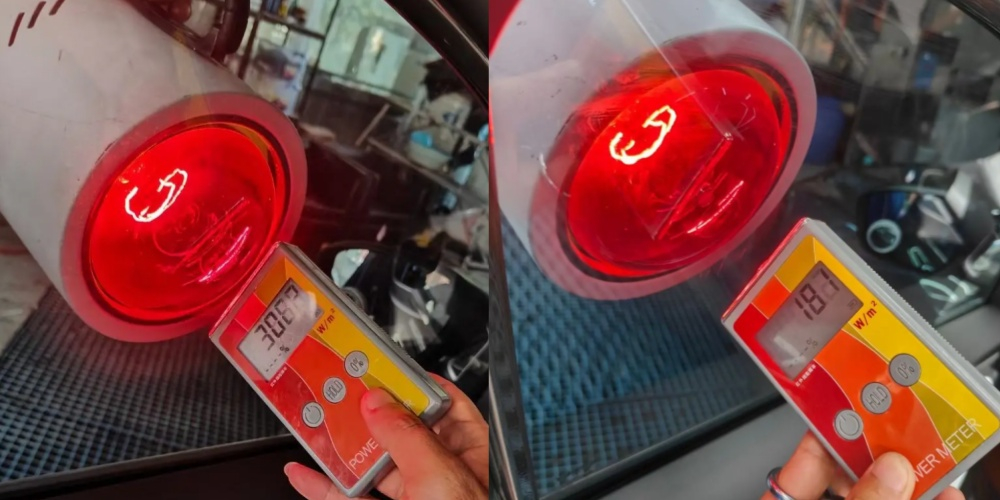
This is where the difference shows up in a heat-lamp demo. We run both films under the same lamp in our Guangzhou lab, so the numbers are directly comparable:
- Regular ceramic: 80-85% infrared rejection, 99% UV
- Nano-ceramic: 90-95% infrared rejection, 99%+ UV
Ten percent does not sound huge. But feel the difference on a 48°C day in Dubai or a 40°C summer in Perth. The car with nano-ceramic stays noticeably cooler, which is exactly what your customer feels the moment they sit in it.
There is also a wavelength issue. Cheap ceramic films reject IR in the 900-1400nm range but let heat through at other wavelengths. Nano-ceramic covers a broader spectrum. When your customer holds a heat lamp on one side and feels the other side, the nano film wins every time.
A practical demo script for your shop: put a 100-watt heat lamp behind a regular ceramic sample and a nano-ceramic sample, both at the same VLT. Ask the customer to hold a hand behind each. The nano side stays cooler — that is the sale, no jargon needed.
One more number worth knowing: the TSER (Total Solar Energy Rejected) for good nano-ceramic runs 55-65%, versus 45-55% for regular ceramic. TSER is the honest overall metric, because it combines visible light, UV, and infrared into one number your customers can actually compare.
A quick word on how to verify these numbers when you source film. Ask for a spectrophotometer report, not a marketing sheet. A genuine nano-ceramic will show a smooth rejection curve across 780-2500nm. If the report only lists one IR number at one wavelength, treat it with suspicion — that is a common trick in the industry.
Also ask how the film performs as it ages. Some suppliers quote fresh-film numbers that drop after a year of sun exposure. A real factory runs accelerated weathering tests and will share the after-UV numbers. That is the difference between a 1-year truth and a 10-year truth.
Clarity: Can Your Customers See the Difference?
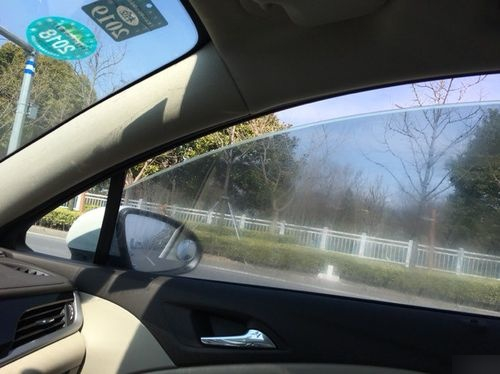
Haze is the silent killer of premium tint jobs. Regular ceramic film, especially in darker shades, can show a slight milky haze at angles — low angle haze, we call it in the factory.
Nano-ceramic has smaller particles that scatter less light. The result: clearer glass, especially at night and in bright sun. A customer who drives a Tesla or a BMW will notice the difference within a day. They will not know why — they will just say the job ‘looks cleaner’.
In our lab tests, nano-ceramic holds under 1% haze after 3 years of UV exposure. Regular ceramic typically starts at 1-2% and climbs. For a premium shop, that clarity is part of the brand you sell.
Here is the test installers use: park a car with regular ceramic and a car with nano-ceramic side by side, both at 35% VLT. Look through the side windows at an angle in daylight. The nano film looks like the glass is simply darker; the regular film can look slightly frosted. It is subtle — but a customer paying premium prices notices subtle.
Durability: Which One Holds Up Over Time?
Both films last a long time — 8-10 years for regular ceramic, 10+ years for nano. The difference shows in extreme climates.
We have installers in the Gulf running our regular ceramic lines for 5+ years with no visible degradation. Nano-ceramic is newer in the market, but the chemistry says it should hold even longer because the tighter particle packing resists UV breakdown better.
Neither fades to purple like dyed film. Neither bubbles like cheap carbon film if the adhesive is good. The real durability question is: do you want to sell a 10-year warranty or a 12-year warranty? Nano gives you the extra margin of safety.
Color stability matters in hot markets. In Saudi Arabia and the UAE, we have seen regular ceramic hold its neutral gray shade for years. Nano-ceramic uses a different color-stable chemistry that resists the slight yellowing some films develop near the glass edge after long UV exposure.
Price Difference: Is Nano-Ceramic Worth It?
Here is the wholesale reality for shops:
- Regular ceramic: roughly USD 4–5 per meter wholesale
- Nano-ceramic: roughly USD 6-20 per meter wholesale
On a typical car install, the film cost difference is maybe USD 40-60. What do you charge the customer? Regular ceramic installs run AUD 650-900 in Perth. Nano-ceramic pushes toward AUD 850-1100.
The math: pay $50 more for film, charge $150 more to the customer. That is a 3x return on the upgrade, plus a customer who perceives your shop as premium. When a shop asks us what to stock, that is the calculation we walk them through.
For a shop doing 30 cars a month, moving half of them to nano-ceramic adds roughly AUD 2,000-3,000 a month in gross profit — without any extra cars through the door. That is the real reason shops make the switch.
There is also a warranty angle. Premium film brands back nano-ceramic with lifetime or 12-year warranties. When you sell a warranty, you are selling confidence — and confidence justifies a higher price. Regular ceramic with a 10-year warranty is still strong, but the nano warranty is an easier upsell because customers intuitively connect ‘more expensive’ with ‘better protected’.
And do not forget the perception effect. A shop that demos nano-ceramic looks like a serious premium installer. That perception raises the average ticket on every job you quote, not just the nano jobs. Several dealers have told us the demo alone changed how customers negotiated their prices.
Which One Should Your Shop Stock?
My honest recommendation after 10 years in this business:
- Stock nano-ceramic as your premium line — the film you demo with a heat lamp
- Stock regular ceramic as your mid-tier line — the reliable upsell from carbon
- Use the demo to move customers from carbon straight to nano when budget allows
In markets where heat is the #1 complaint — Gulf, Southeast Asia, Australia — lead with nano. In cooler, price-sensitive markets, regular ceramic still wins on value.
If you’re sourcing from a manufacturer, ask for the IR rejection curve, not just the headline number. A real factory will show you the full wavelength chart. That is what separates a genuine nano-ceramic from film that is just labeled ‘nano’. At KSB, we publish the curves for our IR Series — that’s why importers in 47 countries trust the number on the spec sheet.
Not sure which line fits your market? Send us your region and your average job price. We’ll tell you which film to lead with — and how to price it so you keep the margin.
And one last tip from the shop floor: whatever film you stock, train your installers to demo it on every quote. A heat lamp costs 30 dollars. It has closed more premium jobs than any brochure we have ever printed. The customer who feels the difference buys the difference — and that is where nano-ceramic earns its place on your wall.
插入内链