
A tint shop in Vietnam shot one 40-second phone video last spring. Just a slow walk around a white sedan with blue chameleon film on the side glass. His bay stayed booked for the next eleven days.
He did not change his prices or run any ads. He simply stocked a film nobody else in his city was carrying.
That is what chameleon film does. It sells itself, and it lets you quote like a specialist instead of a commodity.
Here is how the color shift actually works, what the film earns, who buys it, and how to install and display it without wrecking a $600 job.
How Chameleon Film Creates That Color-Shift Effect
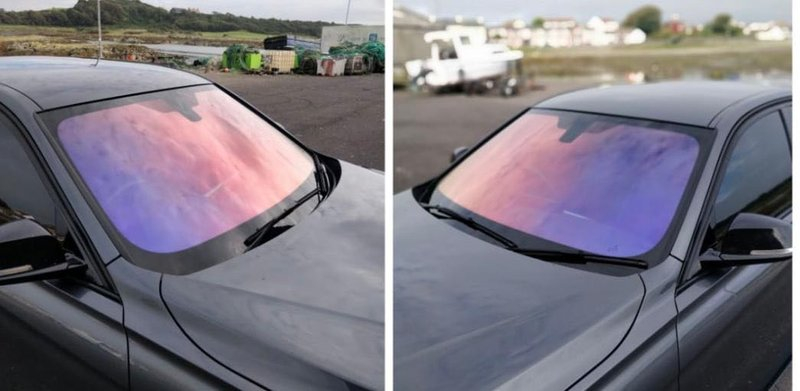
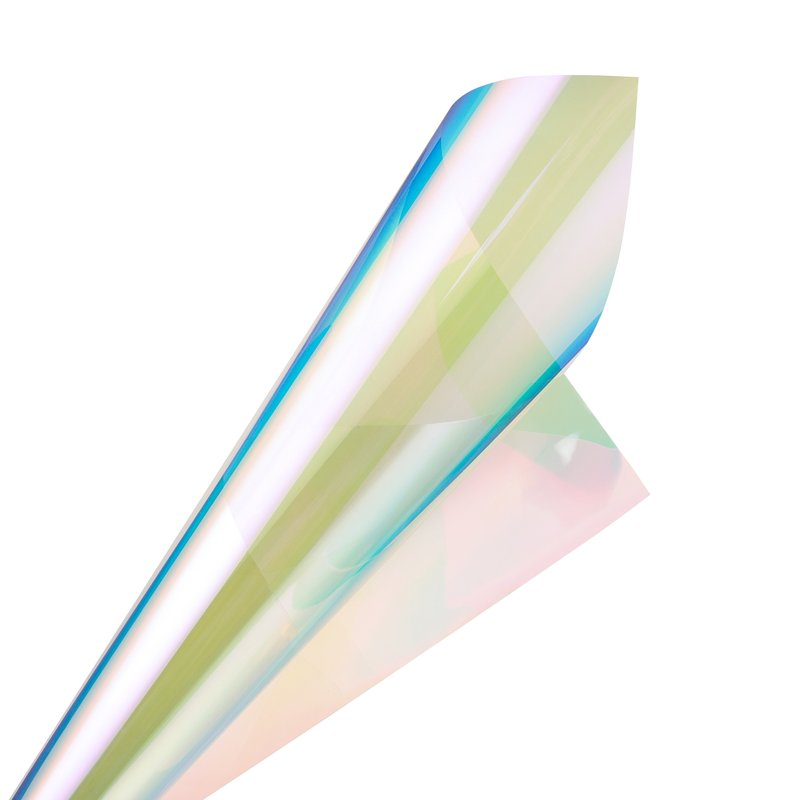
What is chameleon window film, in one line? It is a window film that changes color with the viewing angle, built from dozens of nano-scale metal oxide layers instead of pigment.
The Light Interference Principle, In Plain English
Regular tint gets its color from dye, carbon, or ceramic particles. The color is sitting in the material itself.
Chameleon film gets its color from structure. It is built from dozens of ultra-thin layers of metal oxides, usually titanium dioxide and silicon dioxide, stacked in a repeating pattern.
Sunlight hits those layers and part of the light bounces off every boundary. The reflected waves overlap with each other.
Some wavelengths add up and become bright. Others cancel out and disappear.
Which ones survive depends on how far the light travels through the stack. Change your viewing angle and that distance changes.
That is why the glass reads blue from one side and purple from another. Green or gold shows up as the car drives past you.
You have seen this your whole life. It is the same physics behind a soap bubble and an oil slick on wet asphalt.
What’s Actually Inside the Film
The build runs top to bottom like this. Hard anti-scratch coat, the nano metal oxide interference stack, a PET carrier, pressure-sensitive adhesive, release liner.
Automotive chameleon film measures 1.8 to 3 mil thick. That is roughly 45 to 75 microns, about the same as a premium ceramic tint.
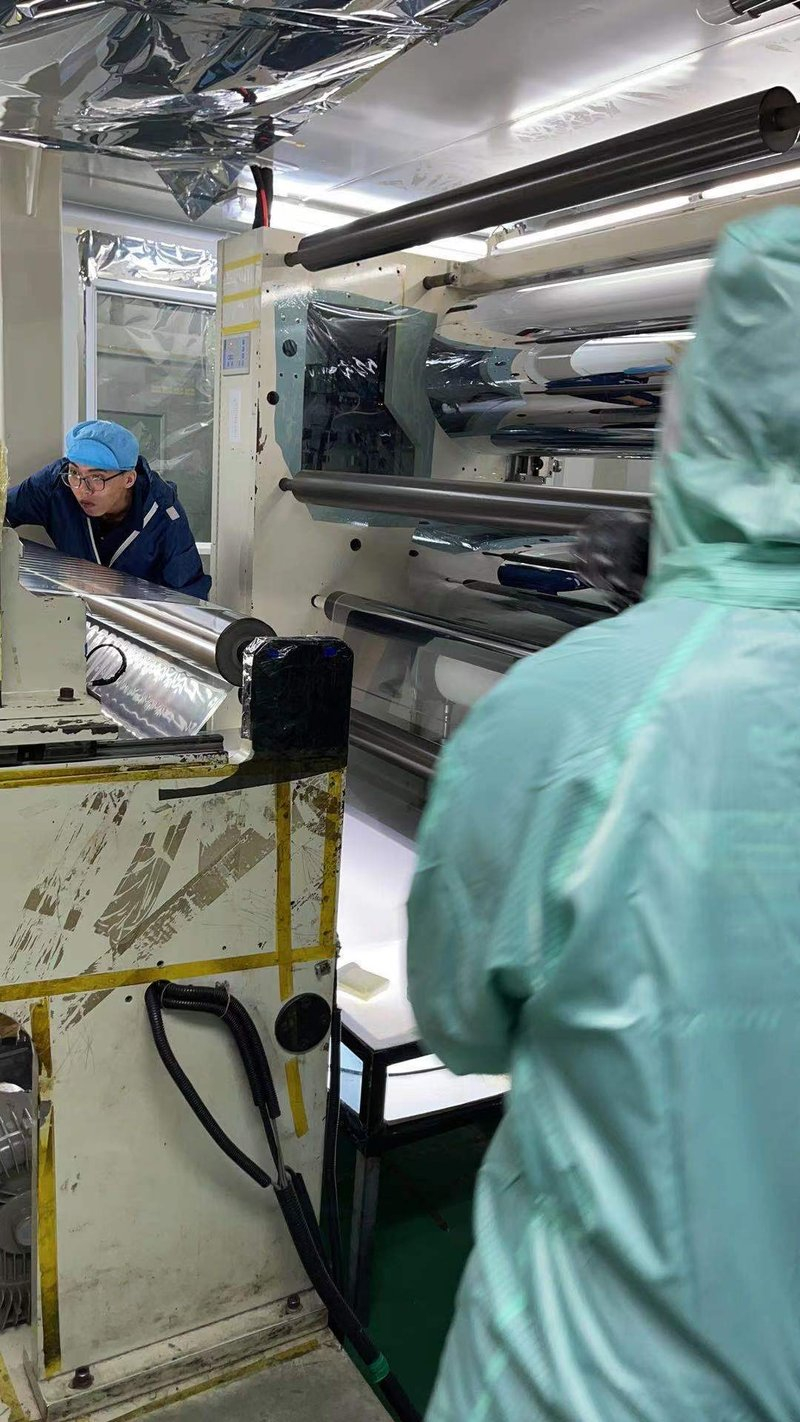
The layers go on by magnetron sputtering or multilayer nano coating. Layer count varies a lot between suppliers, and one US brand markets over 200 layers.
Here is the part that matters commercially. The color lives in the structure, not in a dye, so there is no pigment to break down under UV. That is also why tinted glass sometimes looks lighter a few weeks after installation, as the adhesive and dye settle.
One more thing to check before you buy. Non-metallic chameleon film does not block GPS, ETC, or phone signal. Some older metalized versions did.
Color Options: Blue, Red, Purple, Green, Gold
Blue is the volume seller. KSB’s JP8060 is a blue chameleon film, and blue outsells every other shift in most markets. Blue chameleon window film is now available for bulk order from KSB.
Purple and violet read as luxury. Red and sunset orange sell to the tuner crowd. Green and gold are niche but they photograph beautifully.
VLT on chameleon film usually runs 58% to 85%. Higher VLT keeps the shift subtle and the glass bright. Lower VLT makes it loud.
If you only stock one SKU, stock blue at 80% VLT. It fits the most cars and the most markets.
Why It’s One of the Highest-Margin Products You Can Sell
Premium Pricing Strategy
A standard ceramic tint job on a sedan retails for $250 to $600 in the US. The same car in chameleon film sells for $400 to $750. It is the same logic that builds a window tinting business that holds its margin: a differentiated product lets you quote like a specialist.
That is $150 to $300 more per car for about the same film area and 30 to 60 extra minutes of labor.
Wholesale chameleon film sits only 25% to 55% above a premium ceramic roll. Almost all of that extra ticket price is margin.
Run the numbers on a 1.52 m x 30 m roll. That is 45.6 square metres, enough for 10 to 12 cars of side and rear glass.
Say you pay $210 a roll. That works out to about $20 of film per car. Charge $550 for the job and film is 4% of the ticket.
Now the multiplier. One extra $200 on 40 cars a month is $8,000 of extra gross profit from the same bay. No new lift, no new rent.
And most shops in your city do not stock chameleon film. You are not competing on price. You are the only quote in town. Some shops also keep the SF nano ceramic series on the shelf as a lower-cost cross-sell for price-led walk-ins.
| Feature | Chameleon | Nano ceramic | Dyed |
|---|---|---|---|
| Color mechanism | Structural light interference (metal oxide nano-layers) | Nano ceramic particles | Dye suspended in film |
| VLT range | 20% to 90% (common 58% to 85%) | 5% to 70% | 5% to 50% |
| IR rejection | 65% to 92% | Up to 98% | 5% to 15% |
| UV block | 99%+ | 99%+ | 99% |
| Color stability | No fade (structural) | Stable | Fades over time |
| Lifespan | 5 to 10 years (8 typical) | 5 to 15 years | 3 to 5 years |
| Signal interference | None (non-metallic) | None | None |
| US retail, sedan | $400 to $750 | $250 to $600 | $150 to $400 |
The Types of Customers Who Buy Chameleon Film
The car meet and tuner crowd, roughly 18 to 35. They found you on Instagram or TikTok. They want the loudest shift you have.
Luxury and exotic owners want the opposite end. An 80% to 90% VLT chameleon reads nearly clear in shade and shows a soft purple sheen in direct sun.
Then there are buyers who want privacy without a cave. High-VLT chameleon gives the outside a sheen while the driver still sees clearly at night. That is the same buyer who asks whether window tinting actually gives you privacy, but wants it without a dark cave.
Used-car dealers buy it too. One dealer in our network wraps a single accent car each month and parks it facing the road.
Wholesale and export buyers treat it as a shelf-must-have. In the US, Southeast Asia, and South America, chameleon is what pulls the styling crowd through the door. For these buyers, a step-by-step guide to importing window film for higher profits is the natural next read.
Know your market before you quote a container. The UAE allows black film only, up to 50% on side and rear glass, and bans reflective or coloured finishes.
Saudi Arabia caps rear glass at 30% and prohibits mirror film outright. Fines run AED 1,500 in the UAE and SR500 to SR900 in Saudi.
That does not kill the Gulf business. It changes your product mix. Chameleon sells there for show cars, off-road builds, and exterior windshield film. For that Gulf show-car demand, our colored exterior windshield and sunroof films are the matching line.
Keep VLT high, note it on the invoice, and pair it with a legal ceramic line like XO or NK for daily drivers.
Installation Tips: Chameleon Film Is Not Regular Tint
Directional Grain Will Make or Break the Job
Good chameleon film has a small arrow printed on the backing paper. That arrow is the grain direction.
Every panel on the car must be laid with the arrow pointing the same way, usually toward the front.
Ignore that and the hood shifts purple while the door beside it shifts green. Customers spot it instantly. It is not a warranty claim you can win.
The grain rule also kills your offcut recycling. You cannot rotate a scrap 90 degrees to fit another window.
Budget 20% to 30% more film than a normal tint job. That waste is real, and you should price for it.
Heat Control Is Where New Installers Fail
Chameleon film is more heat-sensitive than ceramic. The interference stack makes the color, and heat changes the stack.
Overheat one spot and the color shifts permanently there. You end up with a dull patch that never matches the rest of the glass.
Cold-stretching is worse. Pull the film over a curve without heat and the multi-layer structure turns milky. The shift dies in that area.
The rule is simple. Heat early, heat evenly, never stretch cold.
Lift the edge, warm it, let the film relax into the curve, then lay it down. Rushing this step is how a $600 job becomes a free redo.
Cure Time and What You Tell the Customer
Post-heat every edge to about 95 °C, or 200 °F. That sets the film’s memory and stops it lifting three weeks later.
Chameleon film cures in 24 to 48 hours, longer in cold or humid weather.
No window rolling for 7 to 10 days. No cleaning during that window either.
Hand over a care card. pH-neutral soap, microfiber cloth, no ammonia, no brush washes, no pressure washing near the edges.
Install time runs 2.5 to 4 hours for a full car. A standard ceramic job takes 1.5 to 2.5 hours. Charge for that extra hour.
How to Display It in Your Shop to Attract Walk-Ins
Display Car Strategy
A roll of chameleon film looks like black plastic. Nobody buys from a roll.
Wrap one display car, or even one spare hood, and park it where the afternoon sun hits it. Angle it so people walking past catch the shift.
Build a sample board. Mount a 30 cm square of each color on a swivel so a customer can tilt it and watch the color move.
Put a price card next to that board. Visible pricing at the display lifts close rate because buyers self-qualify before they ask.
Social Media Marketing With Chameleon
Photograph every chameleon car in the same spot, at the same angle, at the same time of day. Consistency is what makes the shift pop on camera.
The color shift does not show up in a still photo. It shows up in movement. Shoot video, not pictures.
Walk slowly around the car and let the camera angle change. That is the whole piece of content. Ten seconds is plenty.
Before-and-after is the highest-performing format in this trade. Time-lapse installs and heat-gun shrink shots come second.
One install can feed three to five posts. The walkaround, the time-lapse, the release-liner peel, the finished hero shot.
Post five times a week. Shops that hold that pace for 90 days typically grow followers three to five times over.
Geotag every post with your exact shop location and use five to ten local hashtags. Local reach is the only reach that books jobs.
Answer the questions you hear every day, on camera. Is chameleon tint legal here. Will it fade. Batch twenty answers in one afternoon for five months of content.
| Vehicle | Chameleon sides + rear | Chameleon all windows | Ceramic all windows |
|---|---|---|---|
| Coupe | $400 to $750 | $600 to $1,100 | $500 to $900 |
| Sedan | $400 to $650 | $600 to $1,100 | $500 to $900 |
| SUV | $500 to $900 | $750 to $1,400 | $650 to $1,200 |
| Large truck / minivan | $600 to $1,100 | $900 to $1,600 | $800 to $1,400 |
| Luxury / exotic | $800 to $1,500+ | $1,200 to $2,500+ | $1,000 to $2,000 |
FAQ: Chameleon Window Film for Shops and Importers
Does chameleon window film fade over time?
No. The color comes from the film’s layer structure, not from dye, so there is no pigment to break down. Quality sputtered chameleon film holds its shift for 6 to 8 years. That is the heart of what is chameleon window film: a structural color with nothing to break down and fade.
Will chameleon film block my GPS or phone signal?
Not if it is a non-metallic nano version. Older metalized chameleon film could interfere. Confirm the construction with your supplier before you buy a container.
Can chameleon film go on the windshield?
Only at 70% VLT or higher, and only where local law allows. The UAE permits a 15 cm strip along the top edge and nothing more. Treat it as a styling product, not a volume line.
How many cars does one roll of chameleon film cover?
A sedan’s side and rear glass uses about 4 square metres after trim waste. Add 20% to 30% for the directional grain rule. One 1.52 m x 30 m roll covers 10 to 12 cars.
How do I check chameleon film quality before ordering?
Three things. Lay it on a car in direct sun and walk around it. Check the grain arrows line up across panels. Compare it against your ceramic film in shade, not just in sun.
Is chameleon film harder to install than ceramic tint?
Harder than ceramic, yes. Directional grain, heat sensitivity, and more visible seams add one to two hours per car. Installers with solid heat-shrink skills pick it up inside a week.
Get a Chameleon Sample Before You Commit
You do not need a container to test this. KSB ships single sample rolls of the JP8060 blue chameleon film. KSB manufactures the chameleon window tint series, including the JP8060 blue shift, and ships single sample rolls worldwide.
Lay it on one car. Shoot one walkaround video. Watch what happens to your DMs.
If your market runs hot, pair chameleon with XO or NK ceramic for daily drivers. Keep chameleon as the premium upsell. In South America, IR and DD move faster at the volume price point. Pair it with the XO nano ceramic series or the NK nano ceramic series for daily drivers in hot markets, and the IR nano ceramic series or DD nano carbon film where South American volume buyers want a lower price point.
Tell us your market and your monthly volume. We will tell you honestly whether what is chameleon window film belongs on your shelf.