
A car with 35 percent film on the front doors is legal to sell in New York and illegal to drive there.
New York wants 70 percent of light through that window. Factory glass already sits around 73. Multiply the two and you get 26.
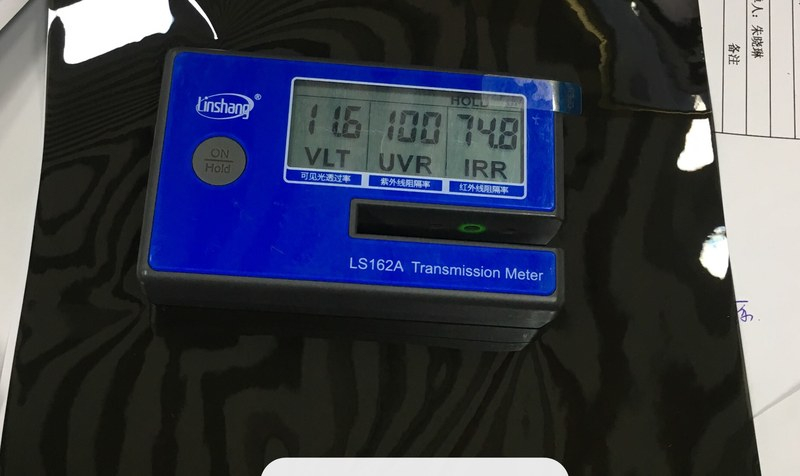
The number on the box is not the number an officer reads off the meter.
US window tint laws are written around that gap.
Almost every state statute measures the window as it sits on the car. Glass plus film, one reading.
So the same roll can be legal on one vehicle and illegal on the next, depending on what glass it lands on.
Manufacturers publish VLT on clear test glass. No car has that glass.
A 35 percent film that reads 35 on the spec sheet reads about 26 on a real door.

The Law Is Written on the Window, Not the Box
What VLT, VLR and TSER Actually Measure
VLT is the share of visible light that gets through. Lower number, darker window. It is the only figure most statutes name.
VLR is the share bounced back. That is the mirror look, and most states cap it separately at 20, 25 or 35 percent. Oregon caps it at 13.
TSER is the share of total solar energy rejected. That is the number that actually cools a cabin, and no state regulates it.
Here is the opening. A legal 70 percent ceramic film can reject more heat than an illegal 5 percent dyed film.
That one fact keeps good shops profitable in the strictest states. It comes down to ceramic versus metal film.
| Number | What it measures | Who limits it | Why you care |
|---|---|---|---|
| VLT | Visible light through the glass and the film together | Every state, on every window | Sets which shades you can sell there |
| VLR | Visible light bounced back off the glass | Most states, capped at 13 to 35 percent | Kills mirror and metalized film |
| TSER | Total solar energy rejected | Nobody | Your only honest selling point in a 70 percent state |
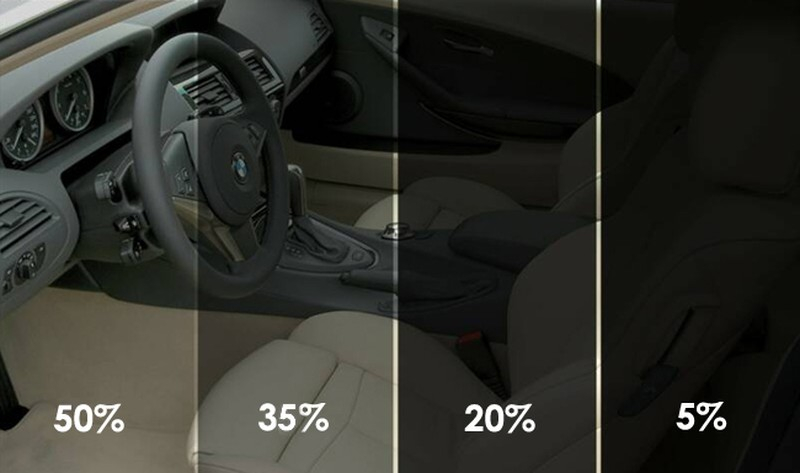
Four positions per car: front side, rear side, rear glass, windshield. Front side is the one that matters, because it is where the driver looks and where police meter.
Behind the driver is looser. Roughly half the states set no limit on rear side glass for cars, and more than that for SUVs.
The windshield is almost never fully filmable. Most states allow a strip above the AS-1 line, or the top four to six inches.
US Window Tint Laws in Plain English
49 CFR 571.205, the federal glazing standard, requires new vehicle glass to pass 70 percent VLT at the windshield and front sides.
That is a manufacturing rule for new cars. It says nothing about aftermarket film. Eight states copied the number anyway.
Where the 70 Percent Floor Comes From
Alaska, California, Delaware, Iowa, New Hampshire, New York, Pennsylvania and Rhode Island sit at 70, and so does Washington DC.
In those states, front door film is close to a clear film only business. The 70 figure came from 1930s glass making limits, not a safety study.
Medical Exemptions: 41 States Have Them, 10 Do Not
41 states and DC issue some form of medical exemption. Ten issue nothing: California, Colorado, Hawaii, Iowa, Kansas, Kentucky, Nebraska, North Dakota, South Dakota and Utah.
New York uses form MV-80W with a sticker on each exempt window. North Carolina issues a five year permit and fines $200 for a missing sticker. Georgia’s is DPS-431, $10 for four years.
Others just want a doctor’s letter in the glovebox. Texas, Michigan and Illinois work that way.
For a shop, an exemption is the best kind of job. The customer already has paperwork and a deadline, so nobody shops it on price.
| Film on the box | Reads on 80% factory glass | Reads on 70% factory glass | Legal front side in a 35% state | Legal front side in a 70% state |
|---|---|---|---|---|
| 90% clear | 72% | 63% | Yes | Only on light glass |
| 80% | 64% | 56% | Yes | No |
| 70% | 56% | 49% | Yes | No |
| 50% | 40% | 35% | Yes | No |
| 35% | 28% | 25% | Borderline | No |
| 20% | 16% | 14% | No | No |
| 5% | 4% | 4% | No | No |
Read the two glass columns and you see why a 35 percent state should install 50 percent film on front doors.
35 percent film on typical 70 percent glass lands at 25, which fails. That is not a legal subtlety. It is a return.
Window Tint Laws by State: The 20 That Matter
Do not read a 50 state chart and pick a number off it. Read twenty and learn the pattern.
US window tint laws fall into four habits: 70, 35, 25 to 33, or no front side film at all.
| State | Front side | Behind driver: side / glass | Windshield | Reflectance cap | Medical |
|---|---|---|---|---|---|
| California | 70% | Any / any | Top 4 in | Must not raise factory | No |
| Texas | 25% | Any / any | AS-1 strip at 25% | 25% | Doctor letter |
| Florida | 28% | 15% / 15% | AS-1 strip | 25% front, 35% rear | Yes |
| New York | 70% | 70% / any with mirrors | Top 6 in | None stated | MV-80W |
| Pennsylvania | 70% | 70% / 70% | No film | None stated | Yes |
| Illinois | 50% or 35% * | No limit | Top 6 in | Nonreflective only | Doctor letter |
| Ohio | 50% | Any / any | 70% | Must not raise factory | Yes |
| Georgia | 28% | 15% / 15% | Top 6 in | 20% | DPS-431 |
| North Carolina | 35% | 35% / 35% | 5 in or AS-1 | 20% | 5 year permit |
| Michigan | No film below 4 in | Any / any | Top 4 in | 35% solar reflectance | Doctor letter |
| New Jersey | No film | Any / any | No film | No mirror film | Limited |
| Virginia | 50% | 35% / 35% | AS-1 strip | 20% | Yes |
| Washington | 24% | 24% / 24% | AS-1 strip | 35% | Yes |
| Arizona | 33% | Any / any | AS-1 strip | 35% | Yes |
| Massachusetts | 35% | 35% / 35% | AS-1 strip | 35% | Decal on glass |
| Tennessee | 35% | 35% / 35% | AS-1 strip | None stated | Yes |
| Indiana | 30% | 30% / 30% | AS-1 strip | 25% | Yes |
| Missouri | 35% | Any / any | AS-1 strip | 35% | Yes |
| Maryland | 35% | 35% / 35% | Top 5 in | None stated | State form |
| Colorado | 27% | 27% / 27% | Top 4 in | None stated | No |
Illinois is the asterisk. It gives 50 percent on the front if nothing behind the driver is under 30, and 35 percent if nothing behind is under 35. A conditional law, not a number.
The Strictest States, and How Shops Still Make Money
In a 70 percent state the average ticket for a legal front door job collapses. That is the complaint I hear from Philadelphia and Buffalo.
Those shops are not poor. They sell something other than the front doors.
Sell Heat Rejection at Legal VLT
A 70 percent ceramic film is not a weak product. Our XO 70 shade rejects about 98 percent of infrared, 99 percent of UV, and over 60 percent of total solar energy.
Cheap film cannot follow. A 70 percent dyed film still only reaches 25 to 35 percent total solar energy rejection. That gap is the product.
In a 35 percent state it is legal on every window, including the front doors. Price it like ceramic, because that is what it is.
The Rear Half Is Where the Margin Hides
| Line you sell | Legal where | Your cost | Price | Bay time | Why it sells |
|---|---|---|---|---|---|
| Clear ceramic, front doors | 70% states | $10 | $180 – 260 | 50 min | The only legal option there. Nothing to price shop. |
| Rear glass only, any shade | States with a rear exemption | $5 | $120 – 180 | 35 min | Legal darkness, and a fast job |
| Clear UV film, full windshield | Most states | $25 | $150 – 300 | 1.5 h | The driver’s biggest heat load |
| 70% ceramic, full car | 35% states | $12 | $399 – 549 | 3 h | Heat rejection with no darkness |
| Visor strip | Every state | $2 | $50 – 80 | 20 min | Cheap add-on, always legal |
| Rear half only, any shade | 35% and up | $6 | $150 – 200 | 40 min | Legal darkness and the best bay-hour |
In a 35 percent state, that same customer can legally go to 5 percent behind the driver. Most of them do not know that.
Price the rear side and rear glass at $150 to $200. Forty minutes, about $6 of film, and roughly $110 to $185 a bay-hour.
Same roll, same bay. A $450 full car takes three hours and leaves about $85 a bay-hour. The smaller job pays better.
The Most Lenient States, and the Biggest Opportunities
At the other end, the front side number runs 24 to 33 percent and everything behind the driver is open.
That is where a 5 percent and 20 percent line actually sells, and where a shop can build a look instead of quoting a spec.
New Mexico at 20 percent is the darkest legal front side window in the country. Montana and Washington sit at 24, Texas, Arkansas and Oklahoma at 25.
Arizona, Texas, Missouri, Nevada, Maine and about a dozen more set no limit behind the driver on passenger cars.
| State | Front side | Behind driver | What to stock |
|---|---|---|---|
| New Mexico | 20% | Any | 20% ceramic as the headline shade |
| Montana | 24% | 14% / 14% | 20% and 35% ceramic |
| Washington | 24% | 24% / 24% | 35% and 20% ceramic |
| Texas | 25% | Any / any | 5% and 20% for the rear, 50% for the front |
| Arizona | 33% | Any / any | 20% and 5% rear, watch the 35% cap |
| Missouri | 35% | Any / any | 5% rear, 50% front |
| Nevada | 35% | Any / any | 5% rear, 50% front |
| Florida | 28% | 15% / 15% | 20% rear, 50% front |
The dark rear is a look, and looks sell. It is also where cheap film fails, which is your replacement market in year three.
In a study of about 1,000 tint orders, 66 percent of replacements happened because heat rejection had faded. Only 27 percent came from visible damage.
Enforcement Is a Separate Law From the Limit
Two states with the same 35 percent number can behave nothing alike. What decides it is who measures, when, and with what. The statute only sets the number. The enforcement tail sets the cost.
Texas stopped safety inspections for non-commercial cars on January 1, 2025. Tint is a roadside matter there now, and the fine runs up to $200.
North Carolina dropped tint from its annual inspection in December 2025 and deleted the $10 fee. In exchange it added a rule: roll down the window the officer walks up to.
New Hampshire repealed the inspection sections behind its tint check from January 31, 2026, so 70 percent front side is now enforced at the roadside.
New York still checks tint at the annual inspection. A car with 35 percent film fails and cannot be registered until it is fixed. That is a removal job with a deadline.
Illinois runs no periodic inspection for ordinary cars, so its conditional rule only meets a meter at the roadside.
| State | First offense | Fix it and it goes away | Who checks |
|---|---|---|---|
| Texas | Up to $200 | Yes, dismissal fee up to $10 | Roadside only since Jan 2025 |
| Illinois | $50 – 500 petty offense | Yes, by court order | Roadside meter |
| New York | Up to $150 | Yes, at inspection | Annual safety inspection |
| North Carolina | Citation, plus $200 if the medical sticker is missing | Yes | Roadside, with a roll-down rule |
| Georgia | Misdemeanor | Varies | Roadside, 3 point tolerance |
| Michigan | Civil fine up to $100 | Yes | Roadside, out-of-state cars exempt |
| New Hampshire | $50 plus assessment, $75 for windshield | Yes | Roadside only since Feb 2026 |
| Virginia | Citation | Yes | Annual inspection, 7 point cushion |
Film does not stay at its rated VLT forever. Light film gets lighter as it ages, which moves a car toward legal and a cheap film toward purple.
How to Stay Updated When the Law Moves
US window tint laws move more often than the articles about them.
Georgia rewrote its statute in HB 1161, signed May 12 and effective July 1, 2026. Front side went from 32 to 28 percent and the rear from 32 to 15.
If you stocked for the old rule, your front side film is now two shades too dark for that market.
New York is the opposite case. A bill to drop 70 to 50 percent passed both chambers on June 2, 2026. As of mid October the governor had not signed it, so 70 still applies.
Shops that installed 50 percent on a headline created a re-tint queue for themselves.
The same Georgia bill shows how thin the wording can be. Its text lists the rear glass twice, at 28 and at 15, and no agency has clarified it. The safe install is 28.
Three habits cover most of this. Read the statute section, not the summary. Check the effective date, not the passage date. Meter the finished car, not the film.
Keep one page per state you sell into, and update it when a bill is signed. The International Window Film Association tracks those bills.
Frequently Asked Questions
Can I sell 35 percent film into a 70 percent state?
You can import and sell it. The customer cannot legally drive it. On 73 percent glass it reads 26, and the driver gets the ticket, not you.
Which state has the darkest legal front side window?
New Mexico at 20 percent. Montana and Washington are next at 24, then Texas, Arkansas and Oklahoma at 25.
Do SUVs follow the same rules as sedans?
Often not. Most statutes split cars from multipurpose vehicles, and rear glass is looser on an SUV. Florida is the exception: 15 percent on a car, 6 percent on an MPV.
Does a medical exemption let me install any shade?
No. Most set a floor. New Hampshire caps a waiver at 35 percent, and Wisconsin caps it at 35 on any window. Ten states issue nothing.
Is clear film on the windshield legal?
It depends on the state and the film. Texas and North Carolina allow a clear UV film across the windshield. Pennsylvania, New Jersey and Minnesota allow no windshield film.
Do out-of-state cars have to comply?
Most US window tint laws follow the car wherever it is driven, and a few states exempt visitors. Michigan’s statute does not apply to a vehicle registered elsewhere.
What does a tint ticket actually cost a shop?
For the driver, $50 to $500 depending on state. For the installer, more. Texas fines a shop up to $1,000 per job for a missing compliance label.
Send Me Your State and Your Glass
If you sell into the US, your product mix has to be built backwards from a meter reading, not from a shade chart.
Send me the state you sell into and the factory glass VLT you see most. I will tell you which shades clear the meter.
In a 70 percent state, quote the lightest shade you have and sell it on heat rejection. In a 35 percent state, 50 percent on the front doors is the safer sale.
The same logic runs in your export markets. The IR ceramic series covers the middle of the range, with XO and NK for Gulf heat and DD for volume carbon work.
For a 70 percent state, XO is the shade to lead with: 98 percent infrared rejected, 99 percent UV, and it still clears the meter. NK holds the same numbers through Gulf summers, DD carries the rear half at volume, and SF sits at the top of the ceramic range.
If you want the whole ladder in one place, the IR series page lists every shade from 5 to 70 percent.